
Blooming
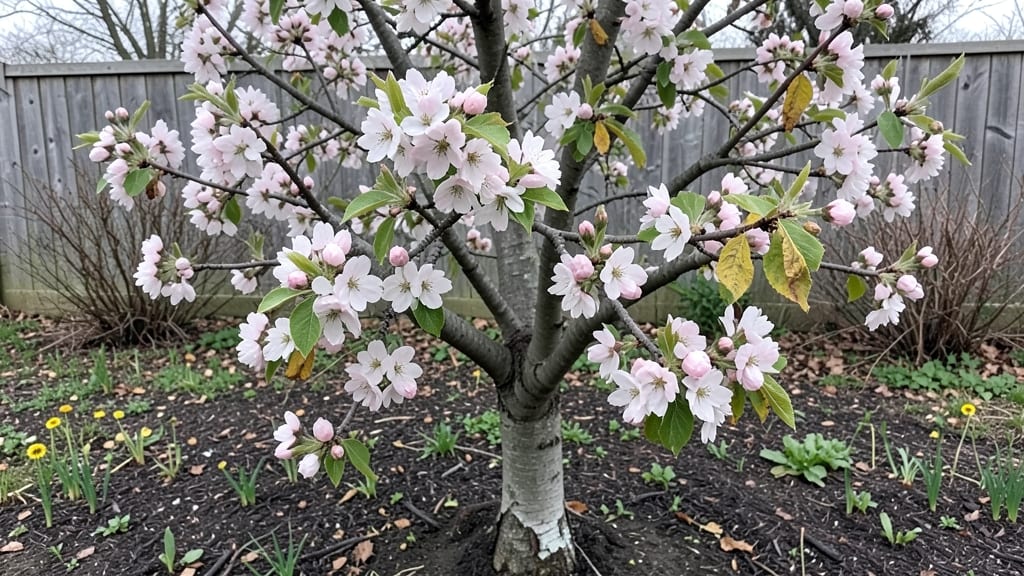
Pear trees do have flowers, producing delicate white or pink blossoms in early spring before fruit develops. These fragrant blooms are essential for fruit production and attract pollinators like bees. Look for clusters of 5-petaled flowers on branches each spring season.
Those early spring blooms aren't just pretty—they're the foundation for your pear harvest! 🌸 The flowers appear in tight clusters called inflorescences, where each delicate bloom contains both male and female reproductive parts, though most pear varieties need cross-pollination from another tree for successful fruit development.
I've noticed that cooler climates often trigger more abundant flowering, while warm spells during bloom can actually reduce fruit set by disrupting pollinator activity.
What makes identification easy is their distinctive 5-petaled structure and sweet fragrance that fills orchards in early spring. The timing varies by region—some varieties bloom as early as February in warmer zones, while others wait until April in cooler areas.
Pro tip: If you're growing pears for fruit, plant at least two compatible varieties within 50 feet of each other to ensure proper pollination and a bountiful harvest.
💡 In This Article
- Pear Tree Flowering Process and Pollination Needs
- Identifying Pear Tree Flowers and Best Bloom Times
Pear tree flowering process and pollination needs
Here's what's actually happening inside that dormant pear tree trunk as winter fades: Flower buds form during the previous summer and fall, developing from specialized cells called axillary buds located in the leaf axils. These buds contain the primordial flower structures that remain dormant until triggered by specific temperature cues.
The magic number is typically 1,000-1,500 chilling hours below 45°F—this cold exposure breaks dormancy and signals the tree it's safe to bloom. Without sufficient chill hours, buds may fail to open properly, a common issue in warmer climates.
The blooming process begins with a rapid expansion of petals over 3-5 days, during which each flower's reproductive organs become fully functional. What's fascinating is how temperature affects this: Ideal bloom conditions are 50-65°F during the day with cool nights.
Warmer than 75°F during bloom can cause flower drop, while nights below 40°F may damage delicate petals.
The flowers themselves are hermaphroditic (containing both male and female parts), but most commercial varieties require cross-pollination between different trees for proper fruit set—this is where bees become essential players, transferring pollen between trees within their 1-2 mile foraging range.
This cross-pollination requirement explains why you often see orchards planted with multiple varieties. For example, 'Bartlett' pears need pollination from 'Seckel' or 'Anjou' trees to produce quality fruit. The science behind this involves incompatibility genes that prevent self-pollination from producing viable fruit.
What most people don't realize is that even with proper pollination, only about 5-10% of flowers typically develop into mature fruit—the rest drop due to resource competition or environmental stress. This natural thinning process actually improves fruit quality by reducing overcrowding on branches.
There are exceptions to this cross-pollination rule: Some newer varieties like 'Kieffer' and 'Moonglow' are self-fruitful, meaning they can produce fruit without another tree nearby. However, these varieties often yield 20-30% less fruit compared to properly cross-pollinated trees. The trade-off is convenience for home gardeners with limited space.
For commercial growers, the choice between self- and cross-pollinating varieties depends on their specific climate and market goals—cross-pollinated varieties generally produce larger, more consistent fruit but require careful orchard planning.
What makes pear tree pollination particularly vulnerable is its timing sensitivity. Flowers open in waves over 7-14 days, and bees must be active during this entire period. Early bloomers risk frost damage that kills flowers before pollination, while late bloomers may miss peak bee activity.
This explains why some years produce bumper crops while others yield almost nothing despite identical care. The solution? Planting a mix of early, mid, and late blooming varieties extends the pollination window and increases the chances of successful fruit set across different weather patterns.
Here's a practical insight: If you're planting a single pear tree in your yard, choose a variety known for its self-fruitfulness like 'Hood' or 'Luckie'—they'll still benefit from cross-pollination but can produce fruit alone.
For maximum yield, though, aim for at least two different varieties within 100 feet of each other. The scent from these flowers can actually be detected by bees up to 1/4 mile away, making proper spacing crucial for attracting enough pollinators to both trees.