
Light Requirements
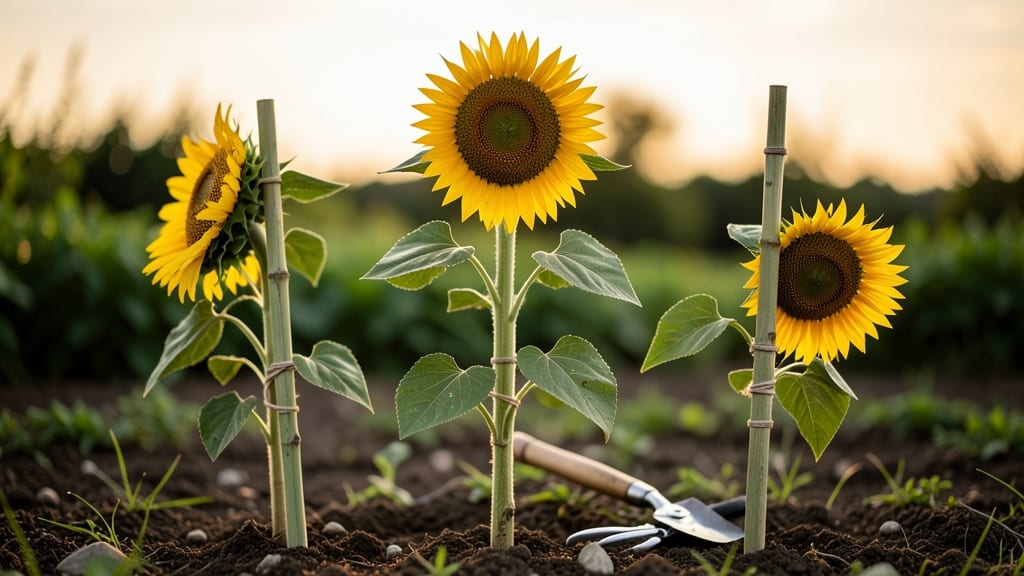
Do sunflowers need to be staked when they reach 6 feet or taller, especially in windy areas or when planted in loose, dry soil where their deep roots can’t anchor properly.
Picture this: a 12-foot sunflower swaying in a summer breeze, its stem bending like a bow. Without support, the plant can snap at the base, leaving you with a broken stem and no blooms.
Yet, not all sunflowers need staking—dwarf varieties or those planted in sheltered spots often stand strong on their own.
Whether your 🌻 sunflowers need support depends on three key factors: their variety, your local wind exposure, and soil conditions. Tall varieties like ‘Russian Giant’ or ‘Mammoth’ almost always require staking, while shorter types like ‘Teddy Bear’ or ‘Sunspot’ rarely do.
Below, I’ll break down when to stake, how to do it without damaging the plant, and natural alternatives to keep your sunflowers standing tall.
You’ll also discover how to choose the right stakes, when to install them, and why some gardeners swear by cages or trellises instead. By the end, you’ll know exactly how to support your sunflowers—without the guesswork.
When sunflowers need staking: height, variety, and wind risk factors
Not all sunflowers need staking, but the tallest varieties often do. Sunflowers over 6 feet tall have weaker stems that can't handle wind or heavy blooms. The key factors are height, variety type, and local weather conditions.
Dwarf varieties under 3 feet usually stand fine, while giants like 'Mammoth' or 'Russian Giant' almost always need support.
Sunflower stems contain lignin-rich fibers that provide natural strength, but this isn't enough for 10+ foot varieties. Wind speeds over 10 mph create significant stress, especially during rain or blooming. Even well-anchored plants can snap when their flower heads exceed 12 inches wide.
Your local climate plays a huge role. In coastal areas with consistent winds, even medium-height varieties may need staking. Meanwhile, inland gardens with calm conditions can often skip support for shorter types. Always consider your microclimate—a sheltered corner might eliminate the need entirely.
Here's how sunflower height directly correlates with staking needs:
The stem diameter is another critical factor. Thinner stems (under 1 inch thick) are far more prone to snapping, especially when carrying heavy flower heads. Even with staking, these varieties need gentle handling during watering to prevent stem damage.
Rain creates additional challenges because wet soil loses stability. When the ground becomes saturated, even well-staked plants can tilt or topple. This is why deep planting (burying 2-3 inches of stem) helps anchor plants naturally. For coastal gardens, consider double-staking or using wide-base supports.
Some gardeners make the mistake of waiting until plants are already leaning before staking. By then, the root system has already shifted, making proper support difficult. The best time to stake is when plants reach 12-18 inches tall, before they develop their primary flower buds.
Remember that organic matter in soil also affects stability. Amending your planting area with compost or aged manure improves root anchorage. For container-grown sunflowers, use pots with at least 12-inch diameter and add gravel for drainage to prevent waterlogging, which weakens stems.
If you're growing sunflowers in urban areas with limited space, consider dwarf varieties like 'Teddy Bear' or 'Moulin Rouge'. These stay under 3 feet tall and rarely need staking, making them perfect for balconies or small gardens.
For maximum height, 'Russian Giant' can reach 14 feet, but this requires professional staking techniques.
Always observe your plants after heavy rains or storms. If you notice stem bending or leaves rubbing together, these are early signs that support is needed. Acting quickly prevents permanent damage and ensures your sunflowers reach their full blooming potential. 🌻
How to stake sunflowers: best methods for support without damage
If you’ve ever watched a 12-foot sunflower sway dramatically in a summer storm, you know why staking matters. While dwarf varieties (under 3 feet) often stand proudly without support, tall sunflowers (6+ feet) benefit from proper staking to prevent stem breakage or root damage.
The key is timing and technique—do it wrong, and you risk harming the plant’s growth. Here’s how to stake sunflowers the right way, from materials selection to placement tips.
Before you grab stakes, know that sunflowers have strong taproots, which anchor them deeply—but their top-heavy blooms can still topple in wind or rain. The best staking methods support without strangling the stem.
Whether you choose individual stakes, trellises, or cages, the goal is to distribute weight evenly while allowing natural movement. Let’s break down the steps to avoid common pitfalls like root disturbance or stem girdling.
-
1Choose the right stakes: Use bamboo stakes (3–4 feet tall) or galvanized metal rods for tall varieties. Avoid plastic—it can overheat in sunlight and harm stems.
-
2Plant stakes early: Insert stakes 2–3 inches deep at planting (not later!) to avoid root disturbance. Space them 6–12 inches from the stem to prevent crowding.
-
3Secure loosely: Use soft plant ties (not wire!) to attach the stem to the stake. Reposition ties every 2–3 weeks as the stem thickens to avoid girdling.
-
4Consider trellises for clusters: For multiple sunflowers, use a wooden trellis or cage system to share support. Space plants 18–24 inches apart for stability.
-
5Avoid over-supporting: Let sunflowers sway slightly—this strengthens stems naturally. Only stake if you see leaning over 30 degrees or stem bending.
One of the biggest mistakes gardeners make is waiting until the plant is already leaning to stake it. By then, the roots may have shifted, and the stem could be too thick for gentle handling.
Always preventative-stake tall varieties like Mammoth or Russian Giant, but skip stakes for dwarf varieties like Teddy Bear or Sunspot, which rarely need support.
For wind-prone areas, consider double staking: use two stakes on opposite sides of the plant, tied at 45-degree angles to the stem. This mimics the natural wind resistance of sunflowers growing in fields.
If you’re using a cage system, opt for wire cages (not plastic) to allow airflow and prevent fungal diseases like powdery mildew.
Remember: Less is more with sunflowers. Over-staking can restrict growth or damage the stem as it thickens. If your sunflowers are healthy and upright with no signs of stress, they’re likely self-sufficient.
Staking should feel like a gentle assist, not a crutch. With the right approach, your sunflowers will reach their full 10–14-foot potential without a single snap or lean.