
Blooming
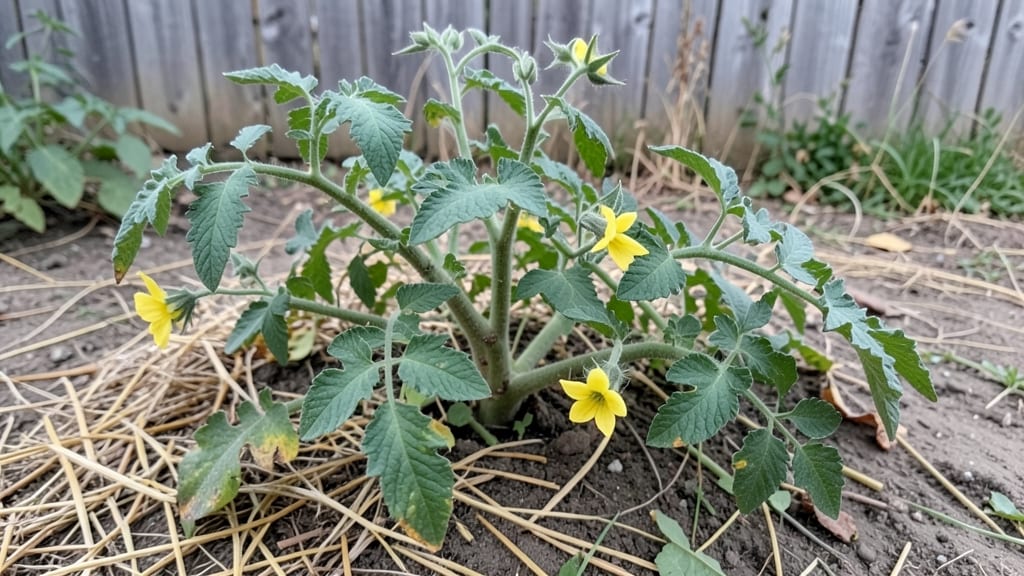
Tomato plants have flowers before producing fruit, and these blossoms are essential for fruit development. Look for small, star-shaped white, yellow, or purple flowers at the plant’s joints, which later turn into tomatoes if pollinated properly.
These delicate blooms appear at the plant’s leaf axils—where the stem meets the leaf—and mark the beginning of your harvest journey. 🌸 The tiny, star-shaped flowers can vary in color from pure white to deep purple, depending on the tomato variety, and they typically bloom in clusters.
Without proper pollination, these flowers will eventually drop, so understanding their lifecycle helps you maximize fruit production.
What’s fascinating is how quickly these flowers transform: within days, a pollinated bloom will swell into a tiny tomato, signaling the start of the fruiting phase.
I always keep a close eye on my plants during flowering—it’s the most critical window for ensuring a bountiful yield, especially in controlled environments like greenhouses or balconies.
💡 In This Article
- Identifying Tomato Plant Flowers and Their Growth Stages
- How to Encourage Healthy Tomato Flowers for Better Harvests
Identifying tomato plant flowers and their growth stages
Tomato flowers are delicate, star-shaped blooms that emerge from the plant's leaf axils—those tiny joints where leaves meet the stem. These flowers typically measure about 0.5 to 1 inch across and feature 5-6 petals arranged in a radial pattern, resembling a tiny yellow sunflower or white daisy.
The center houses the reproductive organs, including the stamen (male parts) and pistil (female part), which are crucial for fruit development.
The color of tomato flowers varies by variety: classic yellow (common in heirloom types), white (like in 'Snow White' tomatoes), or even purple (seen in 'Black Cherry' varieties).
Each flower sits on a short stem that attaches directly to the main stem or leaf junction, often appearing in clusters of 3-5. What's fascinating is how these flowers orient themselves—most face upward, a trait called "epinasty," which helps position them optimally for pollination by bees or wind.
Here's what's actually happening during the flowering stage: After a tomato plant reaches maturity (usually 6-8 weeks after transplanting), it shifts its energy from leaf production to flowering.
Each flower contains both male and female reproductive parts, but they don't self-pollinate easily—waiting for bees or gentle breezes to transfer pollen from stamen to pistil.
Once pollinated, the flower's petals begin to wither within 24-48 hours, while the ovary at the base starts swelling into what will become your tomato fruit.
Tomato plants often produce two types of flowers: early-season blooms that appear when the plant is younger and late-season flowers that develop as the plant matures. Early flowers tend to be smaller and may produce fewer fruits, while later blooms often yield larger tomatoes.
The plant's flowering cycle can last 4-6 weeks, depending on variety and growing conditions. For instance, determinate varieties (like 'Roma') produce flowers in one big flush, while indeterminate types (like 'Sungold') keep blooming continuously throughout the season.
What most people don't realize is how sensitive these flowers are to environmental factors. Temperatures below 55°F or above 90°F can cause flowers to drop before pollination, a condition called "flower abortion." Even slight water stress or nutrient deficiencies (especially phosphorus) can lead to poor flower development.
This is why experienced gardeners monitor their plants closely during the flowering stage—it's the most critical window for ensuring a successful harvest.
When you examine a tomato flower closely, you'll notice fine yellow pollen on the stamens that must reach the pistil's sticky stigma for fertilization. Without this transfer, the flower will simply wilt and fall off, leaving no fruit behind.
This is why hand-pollination becomes essential in greenhouses or during rainy seasons when natural pollinators are scarce. The transformation from flower to fruit is one of nature's most efficient processes—what starts as a tiny bloom becomes a 2-ounce tomato in just 3-5 weeks under ideal conditions.