
Blooming
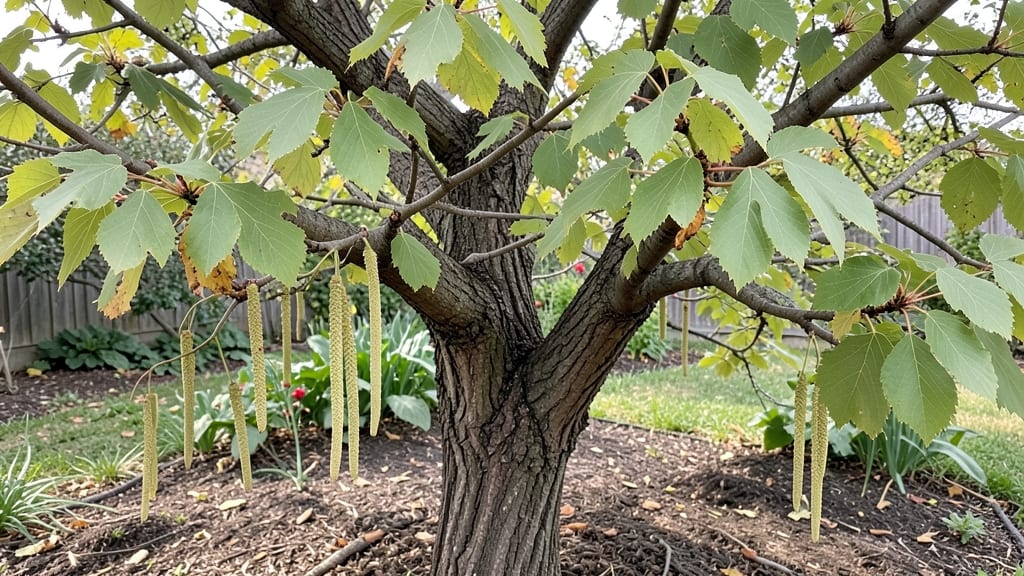
Walnut trees do flower, producing small, insignificant greenish or yellowish catkins in early spring before nut production begins, though these blooms are rarely noticed due to their brief appearance and lack of showiness.
These early-season blooms might seem unremarkable, but they’re the foundation of walnut production. 🌱 Male flowers appear as dangling catkins that release pollen, while female flowers—tiny and tucked near leaf buds—require this pollen to develop into the nuts we harvest later.
Without these quiet blooms, there’d be no walnuts, making them far more important than their appearance suggests.
If you’re growing walnut trees, timing matters—these flowers emerge before leaves in early spring, often when temperatures hover around 50-60°F. 🌿 Proper care, like well-draining soil and minimal stress, helps ensure strong blooms, which directly impacts your harvest.
Even if you don’t notice them, these flowers are doing critical work behind the scenes.
💡 In This Article
- Understanding Walnut Tree Flowering Mechanics
- When and How to Spot Walnut Tree Blooms
Understanding walnut tree flowering mechanics
Here's what's actually happening beneath those unassuming branches: walnut trees are dioecious, meaning male and female flowers grow on separate trees.
The male flowers develop as pendulous catkins (1-3 inches long) that hang like tiny green tassels, while female flowers appear as tiny, scale-like structures clustered near leaf buds - so small they're often missed entirely.
These flowers emerge in late winter to early spring, typically 2-4 weeks before leaves unfurl, when daytime temperatures consistently reach 50-60°F.
The timing is critical because walnut trees rely on wind pollination. Male catkins release pollen when temperatures rise above 55°F, creating a cloud of microscopic grains that must reach female flowers within 24 hours to ensure fertilization.
Female flowers remain hidden among developing leaf buds because their primary function is protection - the delicate flower structures need shelter from wind and cold while still being accessible to airborne pollen. 🌬️ This dual strategy explains why you rarely see female blooms: nature prioritizes function over form when every pollen grain counts for reproduction.
What most people don't realize is the photosynthetic trade-off these trees make. By flowering before leaves emerge, walnut trees allocate energy to reproduction rather than foliage growth.
This means the first 6-8 weeks of spring are a high-stakes period where trees must balance flowering, leaf development, and root growth - all while dealing with variable spring weather patterns. The female flowers' hidden location actually helps conserve moisture by reducing exposed surface area during this critical period.
Environmental factors play a surprising role in bloom quality. Research shows that walnut trees grown in USDA zones 5-9 with well-draining soil (pH 6.0-7.5) produce more vigorous blooms because they experience consistent temperature fluctuations between night and day.
These diurnal shifts trigger hormonal signals that promote flower development. Additionally, trees that receive adequate winter chilling (300-600 hours below 45°F) break dormancy more synchronously, leading to more uniform flowering and better pollination success.
The female flowers' inconspicuous nature serves another purpose: resource conservation. Each female flower requires significant energy to develop into a nut, so trees only produce 10-20% of the potential flowers that could form.
This selective development explains why walnut trees often produce fewer nuts than expected - nature's way of ensuring quality over quantity. The hidden female flowers represent this careful investment in future harvest potential. 🌱
Understanding this process helps explain why some walnut trees produce abundant nuts while others struggle. The key factor is often pollen availability - if male trees are nearby, or if environmental conditions favor pollen dispersal.
For gardeners, this means strategic planting of male and female trees (typically 1 male for every 6-10 females) can dramatically improve nut yields by ensuring adequate pollination during that critical 24-hour pollen window each spring.
Here's a practical takeaway: if you notice your walnut tree has no visible catkins in early spring, it's likely female-only. While these trees can still produce nuts through cross-pollination from nearby males, their yields will be 30-50% lower than properly pollinated trees.
This hidden flowering mechanism explains why some walnut groves appear "bloomless" yet still produce nuts - the flowers are there, just playing by nature's quiet rules. ✨