
Blooming
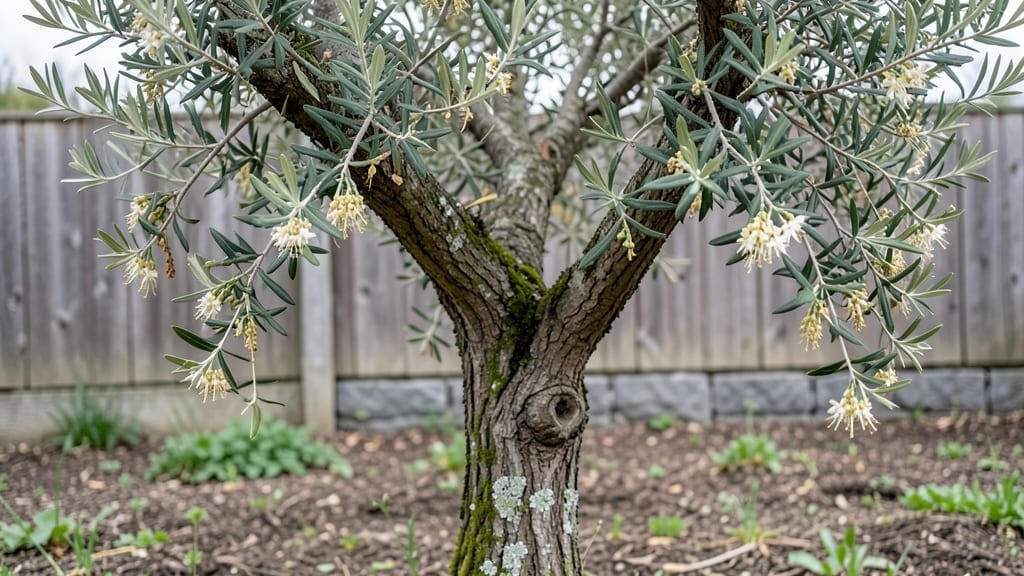
Olive trees do have flowers, producing small, white or greenish blooms in spring before fruit develops. These fragrant, clustered flowers are essential for olive production, requiring cross-pollination by bees or wind to form olives.
These delicate blooms might look modest, but they’re the foundation of every olive harvest—without them, there’d be no fruit. 🌸 The flowering process kicks off in late spring, when clusters of tiny blossoms burst forth, releasing a sweet, honey-like fragrance that draws in pollinators.
What’s fascinating is how environmental factors like consistent temperatures between 60°F and 80°F and 6-8 hours of sunlight daily directly impact their success, making location and care critical for a bountiful crop.
Not all olive trees bloom equally, though—some varieties produce perfect flowers (with both male and female parts), while others rely on imperfect flowers that need cross-pollination from neighboring trees. This is why orchards often plant multiple varieties together to ensure better fruit set.
Even wind plays a role, carrying pollen when bees aren’t around, but a lack of pollinators can drastically cut yields.
💡 In This Article
- Olive Tree Flowering Process Explained
- Maximizing Olive Tree Fruit Production
Olive tree flowering process explained
The flowering cycle of olive trees begins with a burst of tiny, star-shaped blooms in late spring, typically between April and June in temperate climates. These delicate flowers cluster in dense groups along the tree's branches, each measuring just 3-5 millimeters across with four delicate petals.
The blooms emit a faint, sweet fragrance that peaks around midday, designed to attract pollinators during their most active foraging hours. 🌿 This timing coincides with optimal environmental conditions when temperatures hover between 60°F and 80°F and humidity remains moderate.
Here's where it gets botanically interesting: olive flowers come in two primary types. About 10-30% of flowers on a tree are perfect flowers, containing both male and female reproductive parts, while the rest are imperfect flowers that lack one or the other.
This dual system creates a fascinating dependency—perfect flowers can self-pollinate, but imperfect flowers absolutely require pollen from another tree. This is why commercial orchards often plant multiple varieties together, creating a pollination network that can increase fruit set by up to 40% compared to single-variety plantings.
The pollination process itself is a delicate dance between biology and environment. Bees are the primary pollinators, drawn by the flowers' nectar and the 1-2% sugar concentration in their sweet secretion. A single bee can visit 50-100 flowers per minute, transferring pollen between clusters with remarkable efficiency.
However, when bee populations decline—due to pesticides or weather—wind becomes the backup pollinator, though it's far less effective at transferring pollen to the female stigma. 🐝 What's remarkable is how this pollination triggers a hormonal cascade in the flower, causing the ovary to begin developing into an olive fruit within just 7-10 days of successful pollination.
Environmental factors play a crucial role in determining bloom success. Olive trees are particularly sensitive to temperature extremes—prolonged periods above 90°F or below 50°F can cause flower drop, while sudden temperature swings disrupt pollen viability. Sunlight is equally critical, with trees requiring 6-8 hours of direct sunlight daily during flowering.
Interestingly, young olive trees (under 5 years old) often produce more flowers than fruit because their energy is focused on establishing root systems rather than fruit development. This physiological trade-off explains why commercial orchards typically wait 3-5 years before expecting significant olive yields.
The fruit development process begins when fertilized flowers swell into tiny green olives, a transformation that takes about 30 days to become visible to the naked eye.
Here's a little-known fact: the initial fruit set is often 50-70% higher than what will eventually mature, as many young olives are naturally aborted by the tree to conserve resources. This selective process ensures only the healthiest olives develop into the 1-3 inch fruits we recognize as edible olives.
The tree's ability to regulate this process is why olive yields can vary so dramatically from year to year, depending on weather conditions during both flowering and early fruit development stages.
Understanding this flowering process helps explain why olive cultivation requires such careful management. For instance, the Manzanillo variety produces abundant flowers but often needs cross-pollination, while Arbequina trees tend to have more perfect flowers but may struggle in cooler climates.
The key to maximizing production lies in creating optimal conditions during these critical 4-6 week flowering windows—whether through strategic pruning, targeted irrigation, or pollinator-friendly practices. 🌟